Frame Rate Ceiling: The Invisible Hardware Limit Your AAA Games Are Hiding From You
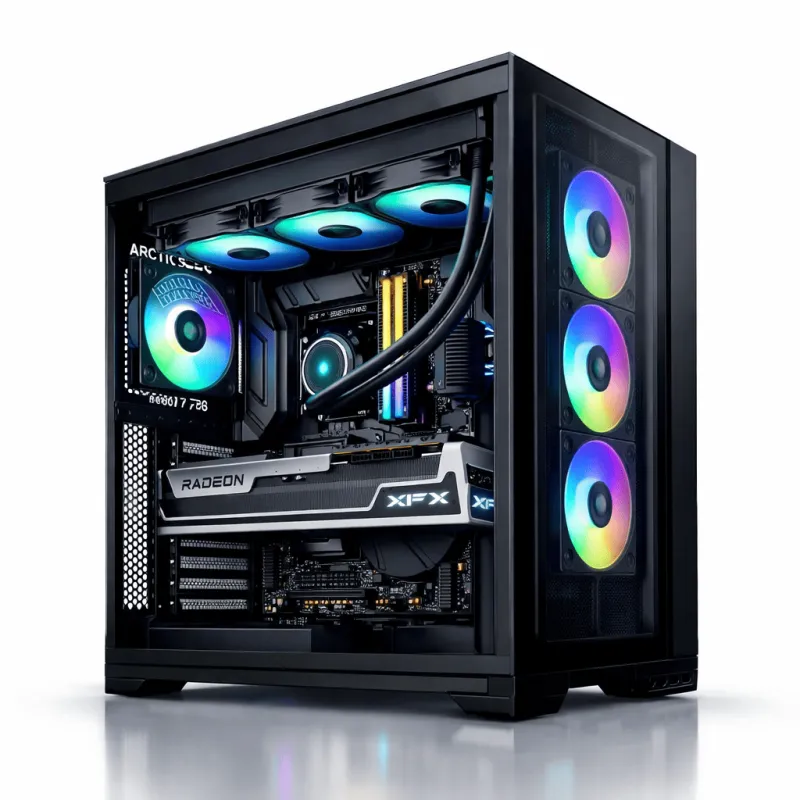
Photo: PC gaming performance 4K hardware official, via caacomputers.com.au
Let's start with a number: $1,400. That's roughly what a mid-to-high tier GPU is running you in 2026 if you bought into the current generation of PC hardware. Add a capable CPU, fast RAM, and a monitor that can actually display what you're paying for, and you're looking at a system that should, by every technical benchmark, be able to run the latest AAA releases at 4K resolution with frame rates pushing well past 100fps.
So why does it feel like the games themselves don't know that?
Across multiple major releases this year, PC players are running into a frustrating and increasingly hard-to-ignore pattern: performance caps, frame rate locks, and optimization gaps that seem to exist not because the hardware can't handle more, but because the game has been deliberately tuned to a ceiling. And that ceiling, more often than not, looks suspiciously like whatever the current-gen consoles can manage.
The Console Parity Problem
Here's the uncomfortable truth that sits at the center of this conversation: most AAA games in 2026 are still being built to a console-first specification. That's not inherently a problem — consoles represent the majority of the playerbase for most blockbuster titles, and designing to a known hardware target produces stable, predictable results. The issue is what happens when that console-first spec gets ported to PC without meaningful optimization headroom built in.
When a game is engineered to run at 60fps on a fixed-hardware console, the path of least resistance for the PC version is to ship with that same 60fps target baked into the performance profile. Unlocking the frame rate requires additional work — stress testing at higher performance envelopes, fixing physics and animation systems that are often tied to frame rate in ways that cause bugs at higher speeds, and sometimes rebuilding rendering pipelines that were never designed to scale past a certain threshold.
That work takes time and money. And in a release calendar as competitive as 2026's, both are in short supply.
The result is a growing library of PC releases that technically run on high-end hardware but don't use that hardware — games where your GPU sits at 40% utilization while the frame counter refuses to budge past 60, where ultra settings look functionally identical to high settings because the asset pipeline was never built to take advantage of the extra VRAM you're sitting on.
The Frame Cap Conversation Nobody Wants to Have
What makes this particularly frustrating is the lack of transparency around it. Performance specifications in marketing materials for 2026's biggest releases have leaned heavily on resolution targets — "4K native," "full ray tracing support" — while quietly omitting any mention of frame rate ceilings until after launch. Review embargoes lift, Digital Foundry runs their analysis, and suddenly the community discovers that the "optimized PC version" is running the same workload as the console build with a mouse and keyboard slapped on top.
This isn't a new phenomenon, but it's gotten more visible in 2026 for a specific reason: PC hardware has outpaced the current console generation by a wider margin than at any point in recent memory. The gap between what a high-end gaming PC can do and what current-gen consoles can sustain has never been larger. And that gap is making the parity ceiling more obvious than ever.
Players who bought into the PC platform specifically to escape hardware limitations are now running benchmarks and watching their $1,400 GPU sit idle while a game designed for a $500 box refuses to let them use what they paid for.
Artificial Throttling vs. Technical Limitation
It's worth being precise here, because the conversation often gets muddled. There are two distinct things happening, and they're not the same problem.
The first is genuine technical limitation — games where the engine architecture, physics simulation, or asset streaming genuinely cannot scale past a certain performance threshold without breaking. This is a real constraint, particularly in open-world titles with complex simulation layers. Criticizing it is fair, but it's a different conversation from what we're really talking about.
The second — and more concerning — is deliberate throttling. Games where the hardware could go further but the performance profile has been capped to maintain parity with console versions, either to avoid embarrassing comparisons, to simplify QA testing, or because the publisher doesn't want PC players to have a meaningfully different experience that might affect multiplatform review scores. This is the pattern that's generating the most friction in PC gaming communities right now.
The tell is utilization data. When a game is genuinely hitting a technical ceiling, your hardware should be working hard to get there. When utilization numbers are low and the frame counter is still capped, that's not a technical limit — that's a decision.
The DLSS/FSR Workaround and Its Limits
The industry's answer to this conversation, delivered with varying degrees of sincerity, is usually upscaling technology. DLSS 4, FSR 4, and their competitors are genuinely impressive tools — they can push effective resolution and frame rates well beyond what native rendering would allow at equivalent performance costs. Studios frequently cite upscaling support as evidence that they're giving PC players a premium experience.
But upscaling is a workaround, not a solution. It addresses the resolution side of the equation more effectively than the frame rate side, and it introduces its own set of tradeoffs — ghosting artifacts, input latency implications at certain quality settings, and a persistent sense among enthusiasts that they're rendering at 1440p and being told it's 4K. For players who invested in hardware specifically to run games at native high resolution and high frame rates simultaneously, "use DLSS" is a deflection, not an answer.
The more honest conversation would involve studios being upfront about what their PC versions are actually optimized for, what the realistic performance ceiling is on a given hardware tier, and what the roadmap looks like for post-launch optimization. Some developers do this. Most don't.
What Needs to Change
The PC gaming audience in 2026 is more technically literate than it's ever been. Benchmark culture, hardware review channels, and performance analysis outlets have raised the baseline understanding of what good optimization looks like. You can't ship a frame-capped port and expect the community not to notice — they will notice, they will document it, and they will remember it at the next release.
What players are asking for isn't unreasonable: honest performance specifications before launch, genuine PC-specific optimization that scales with hardware capability, and a clear distinction between technical limitations and deliberate design choices. That's not a demand for perfection. It's a demand for honesty.
Your hardware is ready. The question is whether the studios building the games you want to play are willing to meet it there.